
Taekwondo vs Karate: What’s the Difference?

Two renowned martial arts disciplines stand out in the dynamic field of Taekwondo and Karate. As interest in these age-old fighting styles grows, enthusiasts frequently ask, “Taekwondo vs. Karate: What’s the Difference?” In this investigation, we examine the philosophical differences, historical origins, tactics, training regimens, and worldwide reach of Taekwondo and Karate. We discover the special qualities that make these martial traditions both interesting and distinctive by analyzing the subtleties that characterize each discipline.
Historical Background: Unveiling the Origins of Taekwondo and Karate
Taekwondo and Karate’s historical origins provide an engrossing tour through several civilizations’ martial traditions.
Origins of Taekwondo
The Korean martial art of taekwondo is influenced by both Chinese and traditional Korean styles. Forming into a separate art form, it captures the spirit of Korea’s martial history, combining elements to produce a fighting technique that is agile and dynamic.
Origins of Karate
On the other hand, Okinawan martial arts traditions are the source of Karate, a Japanese martial art. By skillfully fusing traditional methods with elements of Chinese martial arts, Karate becomes a discipline that prioritizes accuracy, effectiveness, and forceful blows.
Philosophical Differences: Taekwondo vs Karate
Taekwondo Philosophy
The core principle of taekwondo is a strong emphasis on leg kicks and blows. Quickness and dexterity become essential, fitting in with the principles and ethics of martial arts beyond the training area.
Karate Philosophy
Karate focuses on power and accuracy while using both hand and foot movements. It preserves conventional values and beliefs and incorporates them into its training.
Techniques and Movements: Taekwondo vs Karate
Taekwondo Techniques
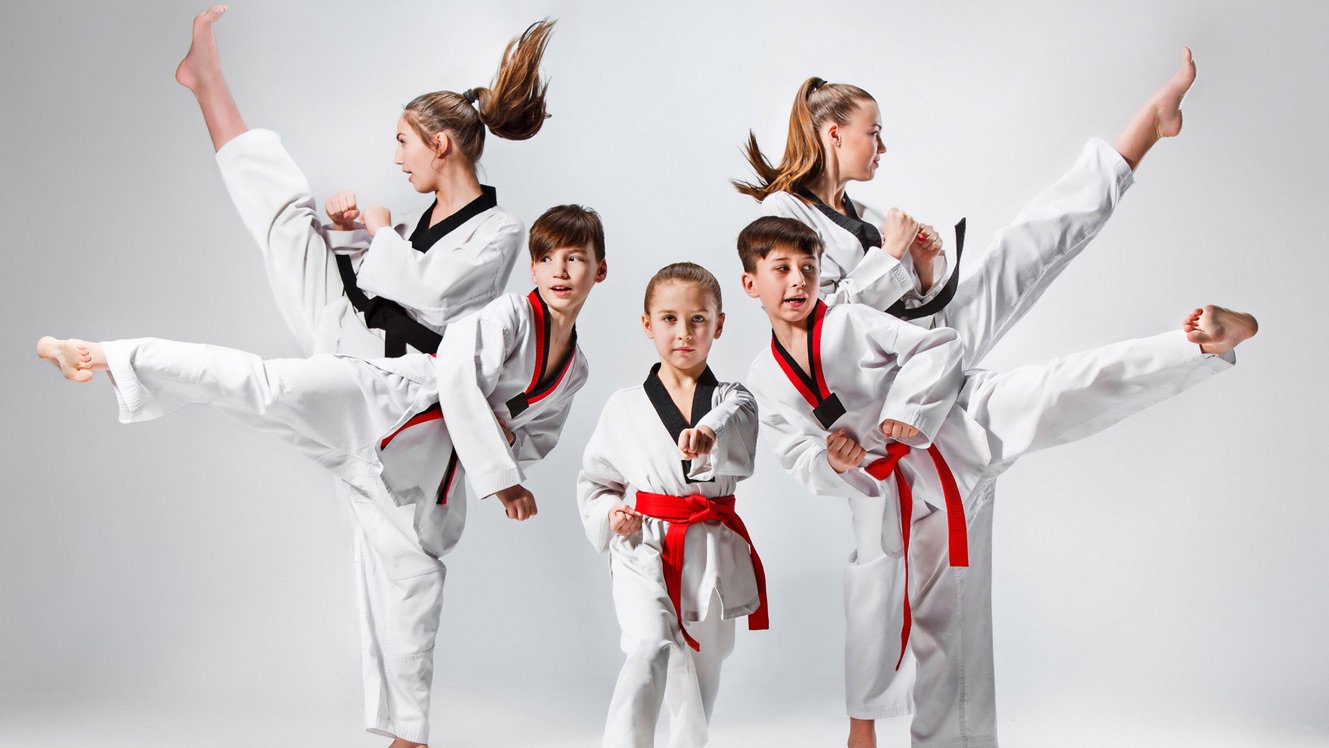
Taekwondo is well known for its dynamic jumping, spinning kicks, and powerful, eye-catching high kicks. The training program of the art features quick footwork that emphasizes agility and speed, producing a captivating variety of moves that distinguish Taekwondo.
Karate Techniques
Karate uses strong straight punches and kicks in a more direct manner. Karate techniques are based on strong stances, and practitioners use a combination of circular and linear motions, emphasizing precise control and powerful strikes.
Training Methods: Taekwondo vs Karate
Taekwondo Training
Taekwondo training includes Poomsae (patterns/forms), where controlled motions are paired with exact choreography. Participants’ reflexes and strategic thinking are developed during sparring sessions. Breaking techniques highlight the dynamic element of the art by showcasing the combination of strength and technique.
Karate Training
Kata, or forms, are how karate training is taught. These are set moves that are performed in a certain order to improve a practitioner’s skill. The sparring part, kumite, improves how skills are used in real-world situations.
Uniforms and Belts: Taekwondo vs Karate
Taekwondo Uniforms and Belts
Practitioners of Taekwondo dress in the traditional Dobok, a clean, white uniform that represents humility and purity. A student’s progress is graphically represented by the color-coded belt system, which goes from white for beginners to black for masters. Every color of the belt has a meaning; it represents how knowledge and skills have developed throughout the Taekwondo program.
Karate Uniforms and Belts
Karate practitioners wear the Gi, a straightforward and useful uniform that promotes fluid motions. Karate’s belt system is based on the Kyu and Dan grades, with colored belts leading to the highly sought-after black belt. Representing a high degree of proficiency, the black belt is closely associated with self-control, dedication, and a thorough comprehension of the fundamentals of Karate.
Competitions: Taekwondo vs Karate
Taekwondo Competitions
Competitions for taekwondo feature exciting, fast-paced matches in which participants score points with precise kicks and punches. The sport became well-known throughout the world and was awarded a coveted Olympic berth. Taekwondo competitions are characterized by a point-based sparring system that emphasizes speed and precision. The sport’s breathtaking athletic displays captivate spectators.
Karate Competitions
Karate competitions, on the other hand, are particularly appealing since they offer a variety of point-and-flag-scoring schemes. The sport’s presence in the Olympic Games highlights how popular it is all around the world. Karate competitions provide practitioners with a stage to demonstrate their skill by emphasizing a mix of strong strikes, precise motions, and tactical use of techniques.
Popularity and Global Presence: Taekwondo vs Karate
Global Appeal of Taekwondo
Taekwondo’s exposure to the Olympics and the participation of well-known practitioners contribute to its popularity, drawing spectators from all over the world.
Karate’s Global Presence
Karate’s historic roots, cultural significance, and popular media and film marketing have contributed to its worldwide popularity.
Conclusion
In conclusion, martial arts Taekwondo and Karate share rich traditions and philosophical foundations, yet they differ greatly in terms of technique, focus, and historical background. Taekwondo is a great option for people who value speed and flexibility since the discipline originated in Korea and places a lot of emphasis on dynamic kicks and flexible footwork. However, Karate, which has its origins in Japan, focuses on strong blows, punches, and a more methodical style of fighting, appealing to those looking for a traditional and disciplined martial art experience. The decision between Taekwondo and Karate ultimately comes down to personal preferences, objectives, and the particular aspects of martial arts that appeal to the individual.


